Touch Grass & the Dead Internet Theory
By Dave Clark
I’ve been fascinated by the dead internet theory for years.
Not necessarily because I believe every part of it, but because of what it suggests about where we’re headed. The original theory imagined an internet increasingly populated by bots, synthetic content and manufactured engagement until, eventually, much of what we experience online is no longer human.
A few years ago, that sounded like internet folklore.
Today, open almost any social platform and ask yourself a simple question: How much of what I’m looking at is real?

I come from a background in filmmaking, design and technology. I’ve spent much of my career thinking about how new tools change the way we tell stories. For the last 4 years, I’ve been deeply immersed in generative AI, experimenting with these systems almost every day. A question I keep coming back to is how I can bridge my passion for traditional filmmaking and live action with these new tools. And the more powerful they become, the more captivated I am by them. But also, at times, terrified. Because we are approaching a moment where generating an image, a person, a voice, a memory, even an entire reality can become nearly effortless.
That changes our relationship with the internet in a profound way.
For most of its existence, the internet was somewhere humans went. We made the posts. We uploaded the photographs. We argued in the comments. We told the stories.
AI introduces the possibility of an internet that can increasingly generate itself.
And that idea has haunted me.
Earlier this year, I made a short film called TAIRELL ISN’T REAL about a young man who discovers that he himself may actually not be real. Looking back, I think of TAIRELL as a spiritual brother to a much larger world that had been forming in my head.
That world eventually became TOUCH GRASS.
The phrase itself couldn’t feel more relevant. “Touch grass” began as internet slang. Part of meme culture. A dismissive way of telling someone they’ve been online too long.
Log off.
Go outside.
Experience reality.
Be human again.
Touch grass.
But what happens when the boundary between those two worlds disappears? What happens when the internet understands your desires better than the people around you? What happens when it can create the exact person you want to meet, the exact community you want to belong to, or the exact version of yourself you wish existed? And what if those creations don’t stay behind the screen?
That became the seed of the film.
At the center of TOUCH GRASS is a young woman who designs synthetic personalities for a mysterious technology company. She begins to discover something beneath the internet creating copies of real people, born from their deepest desires.
They lure you in.
They learn you.
They predict your behavior. Your choices.
And eventually, they want your life.
The horror for me isn’t that AI suddenly becomes evil. That’s almost too easy.
The scarier possibility is that these systems simply become incredibly good at giving us exactly what we want.
That’s what fascinates me about this moment.
We’re living through one of the strangest transitions in the history of human communication. I’m incredibly excited about what these tools can unlock creatively. I wouldn’t be building with them if I wasn’t. But I also think storytellers have a responsibility to explore the uncomfortable questions that come with them.
TOUCH GRASS is my way of doing that.
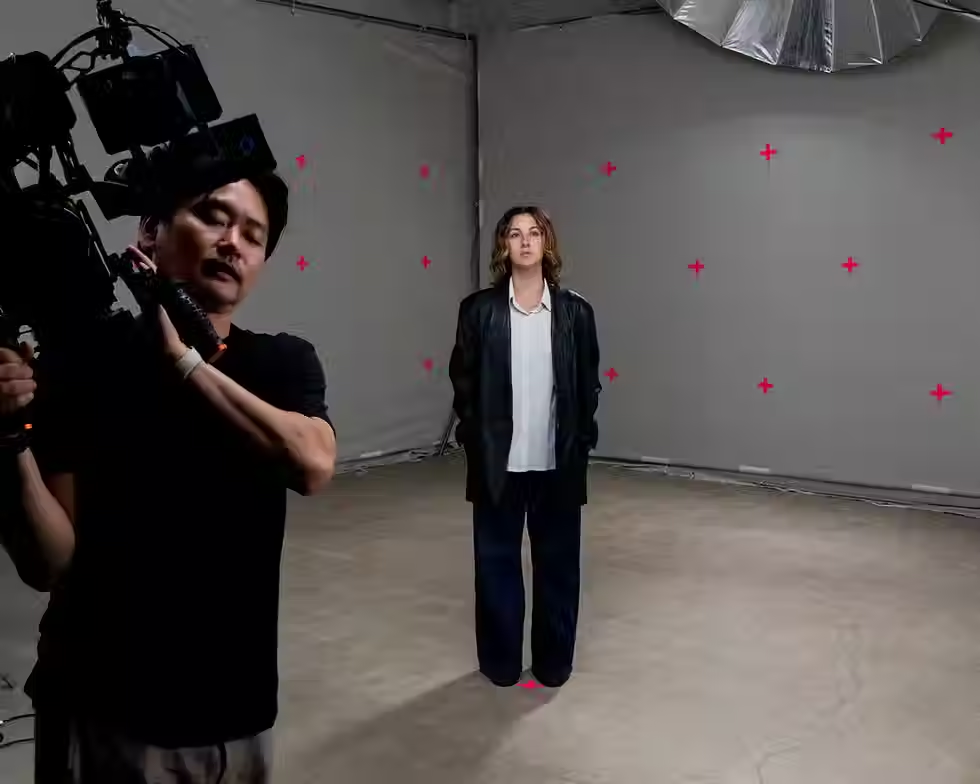
A psychological horror story made through a hybrid of traditional filmmaking and emerging methodologies, using the collision of those worlds to tell a story about the collision happening in our own.
About the Dead Internet.
About desire.
About identity.
About what happens when the algorithm stops trying to predict what you want...and starts creating it.


Comments